
Why Fragmented Data Is Killing Your Real Estate Portfolio Analytics and Decision-Making
Real estate has never suffered from a lack of data—only a lack of clarity.
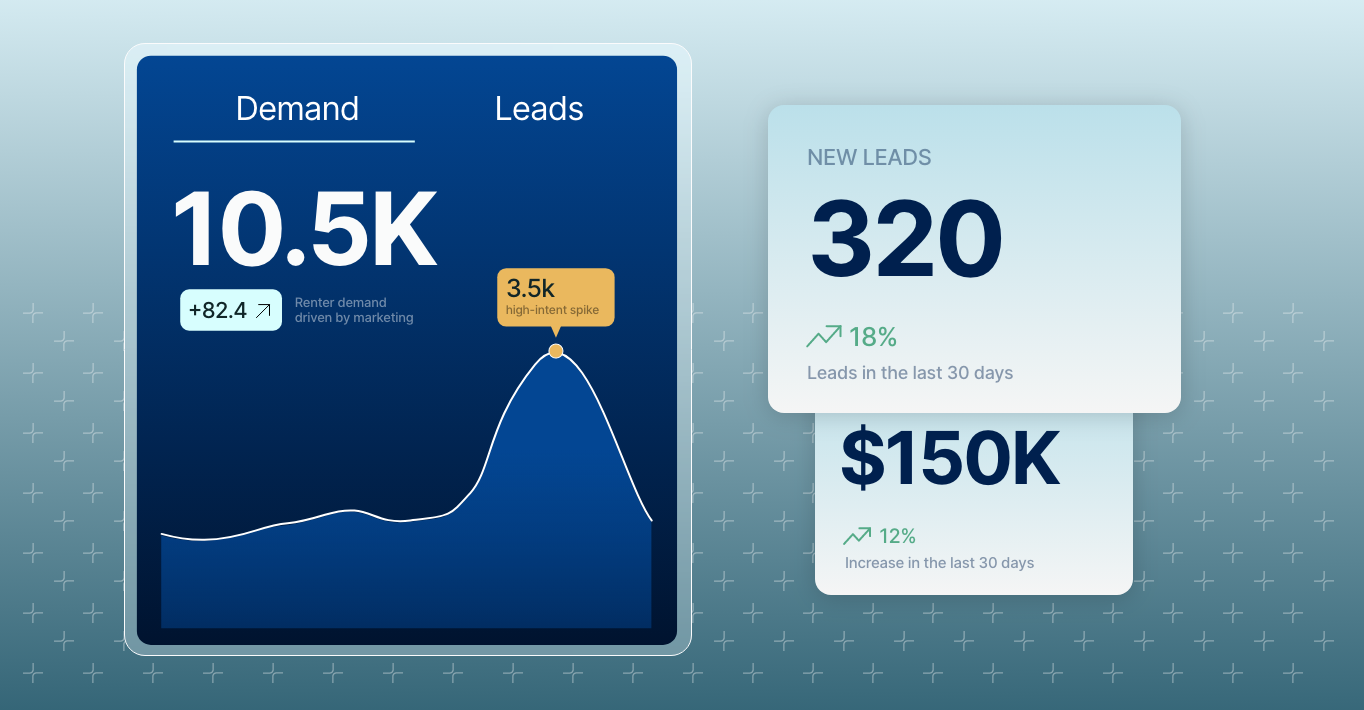
Real estate has never suffered from a lack of data—only a lack of clarity.
Across portfolios of every size—multifamily communities, commercial assets, mixed-use developments—teams are buried in reports, dashboards, and disconnected systems. Leasing tracks one set of metrics. Marketing tracks another. Asset management builds its own models. And leadership is left stitching together a narrative from inconsistent inputs. The result isn't just inefficiency. It's misalignment—and in a market where margins are tighter and competition is sharper, that misalignment compounds.
The gap between data and decision is where performance gets lost.
The real cost of fragmented real estate data
Most real estate owners and operators struggle not with a shortage of data, but with data that is inherently dispersed across asset-level, portfolio-level, and third-party systems. The result is an organization that wants to be insight-driven but is constrained by the infrastructure required to get there.
When teams operate from different systems, even small gaps compound into costly misalignment:
- Pricing decisions lag behind real demand signals
- Marketing spend fails to align with actual conversion drivers
- Leasing teams react instead of anticipate
- Asset strategy becomes retrospective, not predictive
- Leadership cannot benchmark performance across assets in real time
Individually, each function may perform well. Collectively, performance falls short of its potential. And because the gaps are structural rather than visible, they rarely get flagged — let alone fixed.
What unified real estate portfolio analytics actually looks like
The next evolution of real estate performance isn't more data; it's about connected intelligence. Unified real estate portfolio analytics brings together leasing activity, marketing performance, operational inputs, and financial outcomes into a single, dynamic view. Not static reporting. A living ecosystem that unifies data across every system and team, reflecting what's happening now and what's likely to happen next.
This shift changes how decisions are made:
Faster: Real-time visibility replaces delayed reporting. Teams stop working from last month’s numbers and start operating on what’s true today.
Smarter: Insights reflect the full ecosystem—not isolated metrics. When leasing velocity informs pricing, and marketing spend adapts to conversion trends, the analytics become genuinely predictive rather than descriptive.
Alignment: Every team—leasing, marketing, operations, asset management—operates from the same source of truth. Every team works from the same foundation, so strategy moves faster.
Where real estate portfolio performance actually improves
True performance gains don't come from optimizing one function in isolation. They come from alignment across the entire asset lifecycle.
Consider what becomes possible when your portfolio analytics are fully connected:
Leasing teams become proactive. With real-time visibility into pipeline velocity, renewal risk, and lease expiration timelines, leasing professionals move from reacting to anticipating. They can identify at-risk units before they go vacant and focus resources where they'll have the most impact.
Marketing becomes measurable. When marketing data connects directly to leasing outcomes, budget allocation stops being guesswork. Teams can see which channels and campaigns are driving qualified leads and which are spending without converting.
Asset strategy becomes forward-looking. When operational and financial data flow into a shared analytical environment, asset managers can model scenarios, stress-test assumptions, and make hold/sell/invest decisions based on real numbers—not spreadsheet estimates that may already be weeks out of date.
When leasing velocity informs pricing, when marketing spend adapts to conversion trends, when operations feedback into asset strategy—performance compounds. That compounding is the difference between a portfolio that performs adequately and one that consistently outpaces its benchmarks.
Why the industry is moving toward integrated intelligence
The organizations pulling ahead aren't necessarily the ones with the most sophisticated individual tools. They're the ones that have replaced fragmented workflows with a shared analytical environment—one where scenario analysis, leasing optimization, and asset-level decisions all draw from the same underlying data.
This isn't about replacing expertise. It's about amplifying it. The most effective operators won't be those with the most data, but those who can translate it into clear, coordinated action—faster than the competition.
The new standard for high-performing multifamily assets and portfolios
In a market where margins are tighter and competition is sharper; clarity is the competitive advantage. Connected multifamily real estate portfolio analytics isn't a future state — it's the operating standard for organizations that want to perform at the top of their market.
FLOW Intelligence was built to close the gap between data and decision—giving your team a unified view of leasing, marketing, operations, and asset performance in real time. See how FLOW brings connected intelligence to your portfolio. Book a demo.
